
How to trade EUR/USD for beginners
Reading time: 12 minutes
EUR/USD is the most widely traded currency pair in the world, an exchange rate expressing the value of the euro (EUR) relative to the US dollar (USD). Per the Bank for International Settlements (BIS), the USD is on the receiving end of approximately 90% of all trades, while the EUR accounts for about 30% of the global share. So, they are the two most widely traded currencies globally.
It may also surprise you to learn that the BIS reported that trading in the over-the-counter (OTC) foreign exchange (Forex [FX]) market reached an eye-popping US$9.6 trillion per day. By far, the Forex market is the largest financial market in the world.
In this ‘how to’ guide, I will walk you through everything I wish someone had told me at the beginning of my career, covering key components of the EUR/USD, why it matters, and, importantly, how to begin approaching trading it as a complete beginner.
Why EUR/USD is a good starter pair
The EUR/USD trades 24 hours a day, five days a week, and is regularly quoted to four decimal places, making it very easy to read. So, as of writing this article, EUR/USD trades at US1.1639. As the first currency listed in the quotation is the base currency and always denotes one unit, the current quote means that one euro is valued at US1.16 (rounded) in USD terms. The second currency listed in a quote is always referred to as either the ‘quote currency’ or the ‘term currency’.
Early on in my career, I was trading a number of currency pairs. This included major pairs – which are essentially units that always include the USD, like EUR/USD – ‘minors’ which exclude the USD, and some ‘exotics’, which pair an emerging currency with a major currency. I quickly learned that you have to approach trading systematically and focus on one pair at a time. You must learn its fundamentals and get a feel for its price action. Once you do, you can then move to other pairs.
A good starter pair is the EUR/USD. It offers high liquidity, meaning there are always buyers and sellers to trade with, low slippage (the difference between the price you intend to trade at and the executed price), tight spreads (the bid and ask are close together) and sufficient volatility. The pair does not tend to produce wild, inexplicable price swings in the same way you may see in some exotic currency pairs. You can also trade the EUR/USD using leverage, which means you can trade on margin, essentially trading with only a fraction of the notional value. I created this article to help you understand leverage more deeply here.
What drives the EUR/USD?
Central bank bias:
Arguably, the biggest driver of EUR/USD flows comes from central bank policy – for the EUR/USD, that is the European Central Bank (ECB) for the EUR, and the US Federal Reserve (Fed) for the USD. It is not just the interest rate decisions – raise, lower, or hold – that can move currencies; it is market expectations and any signalling from the central banks, too.
All else being equal, when a central bank either signals or raises interest rates, this can bolster demand for its currency due to the better return on USD-denominated assets – assuming we are talking about the Fed.
Economic data (risk events):
Once you have a grasp of what the Fed and the ECB are watching and their overall bias – for example, are they hawkish (raising rates or expected to) or dovish (lowering rates) – economic data will be the next crucial driver for the EUR/USD.
A common way to ensure you are following potentially high-impact data is to simply track what the central bank is watching. This will be made clear in their rate statements at the policy meetings. A good starting point is to follow inflation, employment, and growth (Gross Domestic Product [GDP]).
These three data points, along with other data that signal how they may perform, can move markets violently depending on whether they align with the central bank’s bias. For example, if the Fed is worried inflation is getting out of control, and subsequent inflation data comes in hotter than markets expected, this will increase the likelihood of rate hikes and ultimately drive the USD higher, thereby sending EUR/USD lower. At the same time, if the PMI surveys (Purchasing Managers' Indexes) suggest that price pressures are increasing, this indicates that inflation data may rise, and could have the same market reaction.
It is these data that can offer trading opportunities by exploiting deviations from outcome consensus; these numbers can be found on your economic calendar.
Geopolitical events:
Factors such as elections, trade disputes, and geopolitical crises all affect EUR/USD. The issue is that they are notoriously challenging to trade, with most occurring unscheduled and making it difficult to plan for.
The EUR can be particularly sensitive to internal EU tensions – think of how Greek debt crises or Brexit uncertainty weighed on the currency. I keep a general eye on the news cycle, especially anything involving the eurozone or US economic policy.
Reading the EUR/USD chart
Once you have a handle on the drivers behind the EUR/USD, it is a good idea to become familiar with charting. This is where an understanding of technical analysis helps.
If I were just beginning, I would focus on two core elements: trend identification – understanding which way a market is trading using price action – and basic support and resistance levels. This provides a solid foundation to begin trading this market, especially when macroeconomic conditions align with your technical levels.
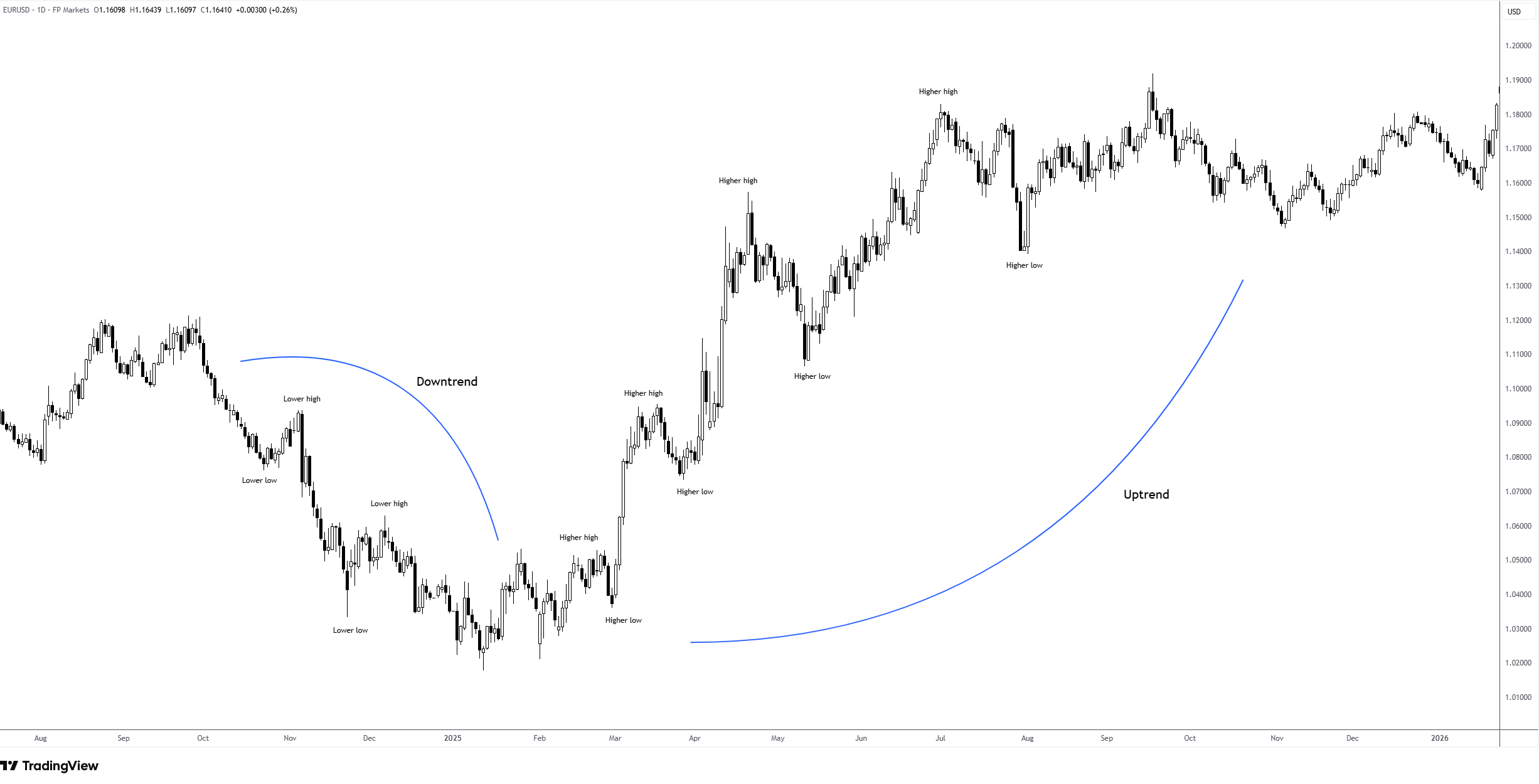
Identifying a trend using price action is a key skill to acquire, and it involves identifying swing highs and lows. As shown in the EUR/USD daily chart below (created using TradingView), we have a clear uptrend (and downtrend) established by a series of higher highs (lower lows) and higher lows (lower highs).
Support and resistance involve finding floors and ceilings on a chart.
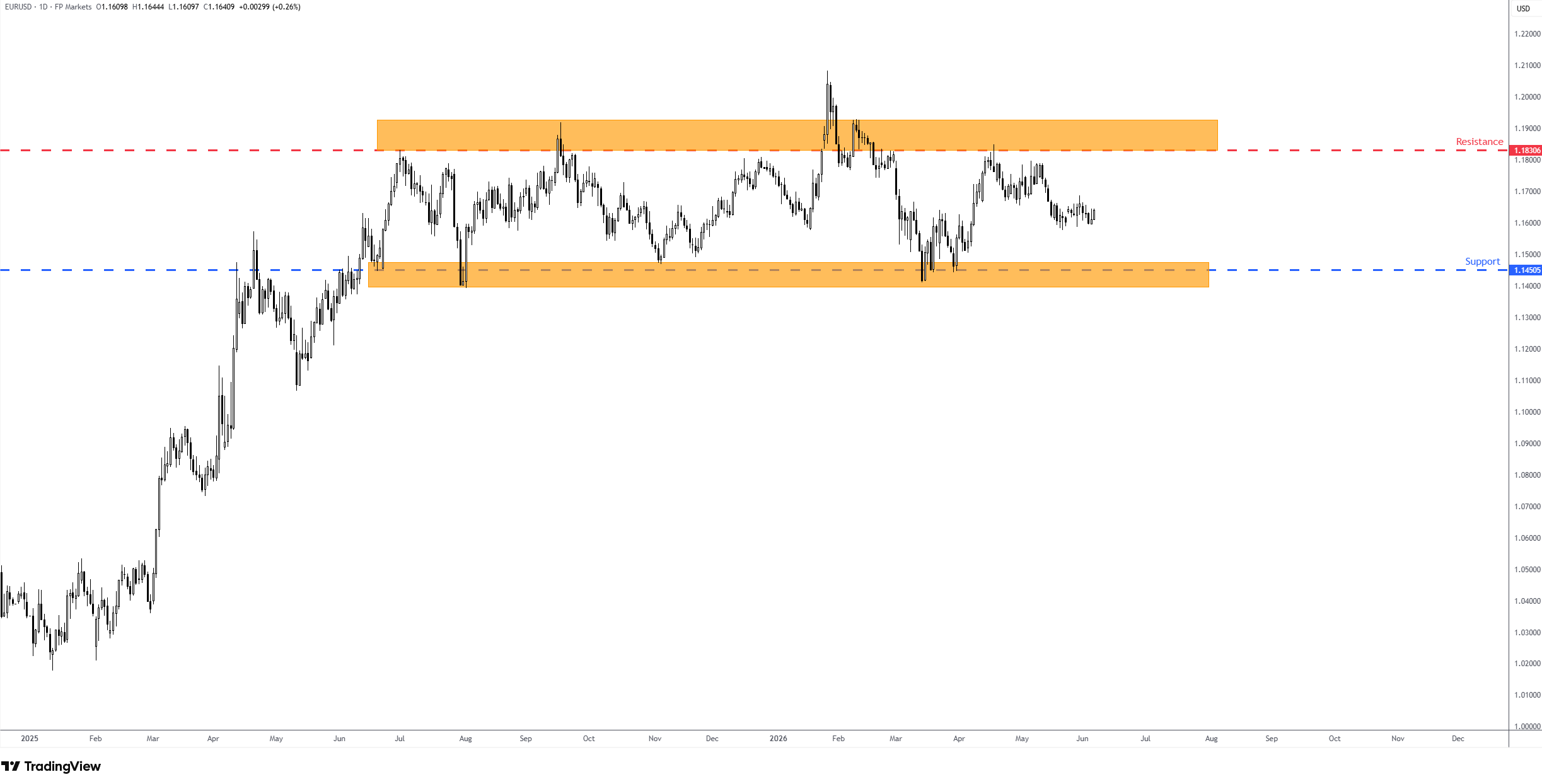
I have added the same EUR/USD daily chart below, depicting basic support and resistance levels. Note that many traders will require at least two points of contact to form support or resistance before trading these levels. As I am sure you have noticed, support and resistance are seldom point-perfect, meaning that there will always be overshoots. The chart shows key levels, but I have also added a zone (orange) around the overshoots to establish an area rather than a defined price point. This helps identify an entry point and an exit level for your protective stop-loss orders.
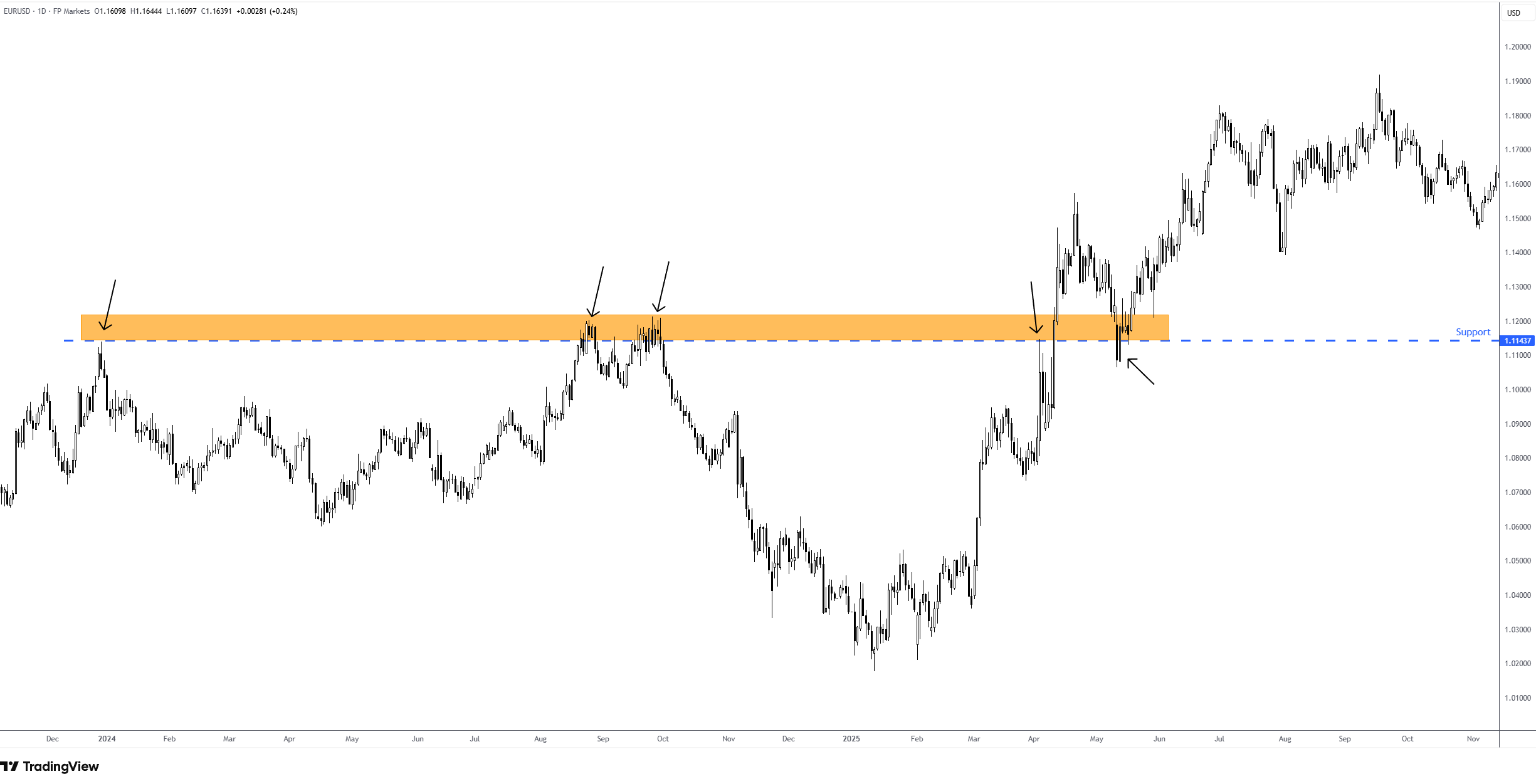
Once you have grasped plotting support and resistance in this way, you will quickly find that once a level cedes ground, it can often be retested and traded as support or resistance. Using the same EUR/USD chart below, you will note that resistance held firm in 2024 but was breached in early 2025, only to be retested as support, offering traders an opportunity to buy into the dip at a resistance-turned-support zone in line with the underlying trend.
Once you become accustomed to trend direction and support and resistance levels, you can then begin adding to your trading strategies if you feel the need to.
This may include technical indicators such as moving averages to help define the trend, the Relative Strength Index (often referred to as ‘RSI’) to assess momentum, and the Average Directional Index (ADX) as another trend indicator. However, do not get caught up in the thinking that more is better, as that is not true in trading. In fact, it is the opposite. I always remind myself that there is no indicator that offers 100% accuracy; the tools used to trade are there to inform my thinking, not to replace it.
EUR/USD: The Forex trading process
Trading should not be a nerve-wracking experience. It should actually be quite boring when done right; the hard work should be complete, with a clear rationale for the trade in place.
In an ideal world, I always advise new traders to take things slow. I know some traders bypass demo accounts, but I feel they provide a lot of useful information for new traders. It gives you an opportunity to familiarise yourself with the trading account’s features and the order functions, as well as allowing you to back-test and forward-test your trading strategies to help ensure they have an edge. An edge essentially means that, over a sufficiently large sample set, your strategy delivers a return.
I also strongly recommend beginning to learn about trading psychology and risk management, which includes understanding how to use protective stop-loss orders and position sizing. A trader who has learnt (and accepts) that trading the financial markets is not about being right or wrong, and understands that they will lose money on some trades, already has a psychological edge over many traders. Couple this with risk management and a well-defined trading strategy, and the trading process should not be frantic or stressful; it will be streamlined.
Everything should be detailed in your overall trading plan. Do not be confused by a trading strategy and the plan. The former is placed inside the latter to form an overall framework for you to follow.
To sum up a EUR/USD trading strategy:
- Start by understanding the central bank’s bias – the Fed and the ECB.
- Align economic data to the central bank themes – these are generally inflation, employment, and GDP.
- Keep an eye on geopolitics and its implications for your trade.
- Plot your trigger numbers from the data. Look for data that could change central bank expectations.
- Chart your levels – apply your technical levels.
- And then wait! Patience is a core skill.
Open an account today and gain instant access to global financial markets, with professional-grade tools, real-time insights, and world-class platforms designed to help you identify and act on trading opportunities as they emerge.
Frequently asked questions (FAQs)
EUR/USD is the world’s most widely traded currency pair and offers high liquidity, tight spreads, and sufficient volatility. Its frequent trading activity can also help reduce slippage compared with some less-liquid currency pairs.
Key drivers include European Central Bank (ECB) and US Federal Reserve (Fed) policy, economic data such as inflation, employment and GDP, and geopolitical events. Market expectations around central bank decisions can also influence the pair.
Beginners can start by learning how to read price action, identify trends, and plot support and resistance levels. Using a demo account can also help familiarise new traders with order functions and test trading strategies before committing capital. Risk management, including protective stop-loss orders and appropriate position sizing, should also form part of a trading plan.
Written by FP Markets Chief Market Analyst, Aaron Hill